
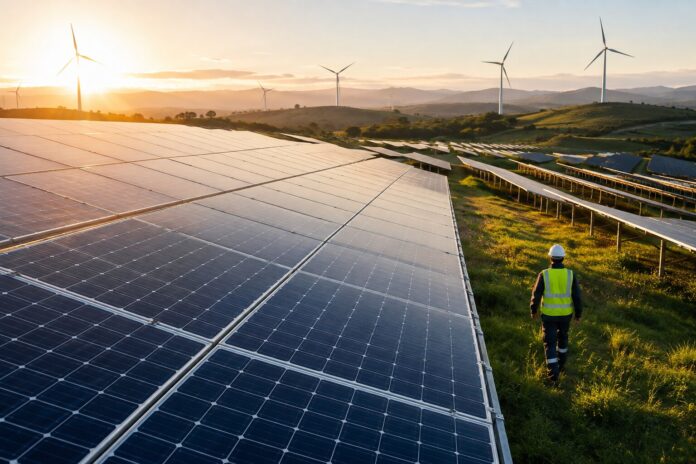
The world wanted much more electricity in 2025. Solar power showed up with an extremely large delivery.
According to the International Energy Agency’s Global Energy Review 2026, solar photovoltaic generation grew by roughly 600 terawatt-hours during 2025. That single-year increase was the largest ever recorded for any electricity source, apart from unusual rebound years following global shocks such as the COVID-19 pandemic.
Even better: solar alone supplied around 70% of the world’s growth in electricity generation.
First, what is a terawatt-hour?
A terawatt-hour, or TWh, is a huge unit of electricity—one billion kilowatt-hours. The 600 TWh added by solar in one year is therefore not a collection of cute rooftop panels making a statistical cameo. It is power-system-scale change.
Total solar generation reached nearly 2,700 TWh in 2025, more than double its 2022 level. Solar’s share of global electricity climbed above 8%.
China installed and generated the largest amount, but the surge was not limited to one country. Solar generation also increased by at least 20% in the United States, India and the Middle East, according to the IEA.
Clean electricity grew faster than electricity demand
Global electricity generation increased by more than 850 TWh in 2025. Renewable and nuclear generation together rose by more than that entire amount.
How is that possible? Because fossil-fuel generation slipped slightly at the same time.
Coal-fired generation fell by about 0.5%. That was its first decline since 2019, excluding the pandemic shock of 2020. Natural-gas generation increased only modestly, while oil-fired generation fell.
Renewables reached about 34% of global electricity generation, up from 32% in 2024 and 23% a decade earlier. Add nuclear power, and low-emissions sources supplied 43%—their highest share in 50 years.
Renewables also came within touching distance of coal, with each providing about 34% of global electricity. Different datasets and rounding methods can place the finish line slightly differently, so the careful wording is that renewables virtually matched coal in 2025. The IEA expects renewables to take a clear lead in 2026.
Why solar is moving so quickly
Solar panels can be deployed at many sizes, from a single home to a vast utility-scale project. Manufacturing has expanded, costs have fallen dramatically over the long term and many countries want more locally produced electricity.
Solar also has a practical superpower: speed. A solar project can often be built faster than a large conventional power station. That matters when electricity demand is rising because of air conditioning, industry, electric vehicles and data centers.
But the sunshine comes with homework. Solar output changes with daylight and weather, so grids need more storage, stronger transmission lines, flexible demand and other power sources that can balance the system. Building panels without upgrading the system around them can lead to bottlenecks and wasted electricity.
The direction is now visible
Fossil fuels still produced more than half of the world’s electricity in 2025, and coal remained the largest single source. Global energy-related carbon dioxide emissions also rose by about 0.4%. This is progress, not mission accomplished.
Still, something important changed: a large rise in electricity demand no longer required a large rise in fossil-fuel power. Solar carried most of the extra load, low-emissions generation grew faster than total supply and coal generation edged down.
Ten years earlier, renewables supplied about 23% of global electricity. In 2025, they supplied roughly one-third. The energy system is enormous and slow to turn—but solar’s record year shows that it is turning.
Sources
- International Energy Agency — Global Energy Review 2026: Electricity supply: https://www.iea.org/reports/global-energy-review-2026/electricity-supply
- International Energy Agency — Global Energy Review 2026: Global trends: https://www.iea.org/reports/global-energy-review-2026/global-trends
- International Energy Agency — Electricity 2026 executive summary: https://www.iea.org/reports/electricity-2026/executive-summary