
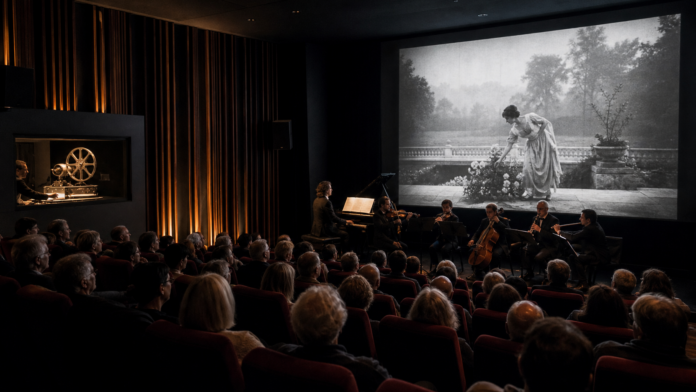
MoMA’s latest Silent Movie Week brought seven restored films, reconstructed music, and newly recovered theatrical versions back before audiences in New York.
A week built around cultural recovery
Some good news arrived from a century ago this summer. The Museum of Modern Art in New York devoted seven consecutive evenings to recently restored silent films, giving audiences a chance to see works whose original form had been obscured by time, incomplete copies, or decades of limited access.
Silent Movie Week ran from July 29 through August 4. According to MoMA, its fourth annual edition was the first composed entirely of restorations drawn from the museum’s own collection. The program brought together films directed by figures including D. W. Griffith, Buster Keaton and Donald Crisp, Raoul Walsh, Ernst Lubitsch, Charles Chaplin, John Ford, and F. W. Murnau.
The achievement was not simply that old films were screened again. Restoration can recover editing choices, image detail, running order, music, and other elements that shaped the experience intended for original audiences. In this case, all seven restorations were shown in MoMA’s theaters for the first time. The museum identified three presentations as world premieres and four as American premieres.
Two films regained their original theatrical shape
Among the most significant results were restored versions of The Student Prince in Old Heidelberg, released in 1927, and Chaplin’s 1918 films A Dog’s Life and Shoulder Arms. MoMA says these works were returned to their original United States theatrical-release cuts for the first time since their premieres.
The survival story behind The Student Prince in Old Heidelberg is particularly striking. MoMA reports that the print in its collection was recently determined to be the only surviving copy of the version shown to American audiences in 1927. That makes the restoration more than a technical upgrade: it restores access to a version of the work that might otherwise have disappeared from public view.
Independent coverage published before the series confirmed the screenings and highlighted the rarity of several surviving prints. Critic Tim Page also noted that the program included What Price Glory and 3 Bad Men, two films whose original negatives no longer exist. Their return to a cinema screen demonstrates why archives matter even when a title appears to have survived: the quality, completeness, and historical form of the surviving material can differ greatly.
Music helped complete the picture
Silent cinema was rarely experienced in complete silence. MoMA paired every screening with music, continuing a performance tradition that once involved pianists, organists, ensembles, and prepared scores.
For the opening presentation of the 1920 film Way Down East, music scholar Gillian B. Anderson led a 10-piece orchestra performing her newly reconstructed score. The series also featured a newly recorded orchestral score for Ford’s 1926 film 3 Bad Men, commissioned by MoMA and written and conducted by Timothy Brock.
These musical projects show that preservation extends beyond repairing or scanning images. A score can supply rhythm, emotional emphasis, and continuity, influencing how a film is understood. Reconstructing one requires its own research and interpretation, while a new commission can create a bridge between historic images and present-day listeners.
Preservation becomes meaningful when people can see the work
MoMA describes silent film as a commercially dominant medium that lasted for roughly three decades, from the late nineteenth century into the early sound era. The museum estimates that only about 20 percent of films made between 1895 and 1930 survive. That estimate, attributed here specifically to MoMA, gives the week’s seven restorations a sobering context without diminishing the positive result.
Archives do essential work in controlled storage and specialized laboratories, but preservation reaches a different stage when a restored film meets an audience. Public screenings allow viewers to encounter historic works as moving images rather than as titles in a catalogue. Live accompaniment makes that experience communal and reminds audiences that cinema has always joined technical invention with human performance.
The series also offers a practical model for cultural stewardship: collect fragile materials, research their histories, restore what can be responsibly recovered, document the work, and then share it. Each step requires time and expertise, yet the result can return an endangered piece of cultural memory to active life.
Not every lost frame can be recovered, and no restoration can recreate every detail of a premiere from a century ago. Still, this program shows what careful preservation can achieve. Seven films were not only protected as artifacts; they were heard, seen, and discussed again. For audiences and future filmmakers alike, that is a hopeful form of continuity—the past becoming available for another generation to discover on its own terms.