
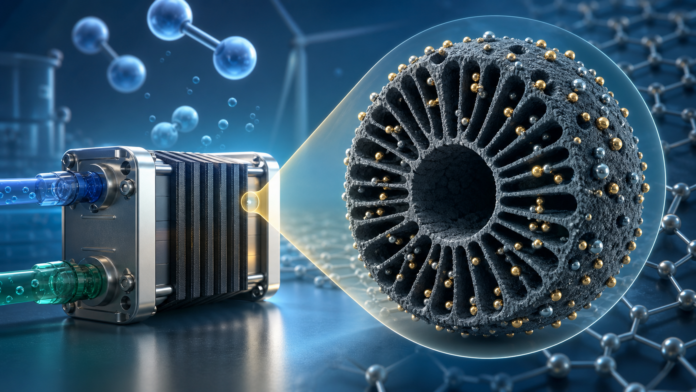
A Washington University-led team has designed a platinum-cobalt catalyst that kept 85 percent of its performance after 150,000 severe voltage cycles in laboratory testing.
Hydrogen fuel cells have a simple promise: turn a chemical reaction into electricity, with water and heat as the other products. Their wider use has been limited by a less glamorous problem-catalysts can lose performance as they operate, while platinum is costly and difficult to use efficiently.
New work published on August 6 in Nature Nanotechnology tackles both challenges at the scale of a few billionths of a metre. Researchers from Washington University in St. Louis, Brookhaven National Laboratory, Lawrence Berkeley National Laboratory, Northeastern University and the University of Pittsburgh built a porous carbon support with a distinctive radial pattern of nanochannels. The structure holds tiny platinum-cobalt particles in place while allowing the fuel-cell reactions to keep moving.
A scaffold for very small particles
Platinum is an effective catalyst, but the smallest particles can dissolve, migrate or merge during operation. Larger particles last longer, yet expose less surface for the chemical reactions that make electricity. The team’s design aims to avoid that trade-off.
The support is made of hollow carbon spheres with ordered channels radiating through them. Those channels provide space for protons, oxygen, water and an ion-conducting material to move through the electrode. At the same time, they confine platinum-cobalt nanoparticles so the researchers can heat them to 1,000 °C and form an ordered intermetallic structure without letting the particles clump together.
That description matters because it is a materials result, not a claim that a new fuel-cell system is ready for sale. The work shows how a carefully shaped support can influence a catalyst’s structure and durability under controlled tests.
What the laboratory test showed
In the reported accelerated durability test, the catalyst retained 85 percent of its performance after 150,000 severe voltage cycles. The researchers estimate that this could correspond to roughly 25,000 hours of operation, but that estimate is not the same as a field demonstration over 25,000 hours.
The experiments also kept the particles smaller than 5 nanometres while maintaining an even distribution. The combination of small particles, ordered atoms and open channels produced what the university described as a way around the usual activity-versus-stability compromise.
The paper compares the result with performance targets used in fuel-cell research, but it does not demonstrate a complete commercial device, a vehicle, or a data centre running on the new material. Those next steps will require additional engineering, scale-up and independent testing.
Why the result could matter
The researchers point to several possible applications, including transportation and stationary electricity generation. Data centres are one example of why people are looking for more durable ways to produce power: their computing equipment and cooling systems are increasing demand on electricity networks.
A fuel cell supplied with hydrogen or another fuel could generate electricity at the point of use. Whether that reduces emissions or costs depends on how the fuel is made, how the system is built and how it performs outside the laboratory. The new catalyst does not answer those broader questions, but it addresses one practical bottleneck-keeping an active material working for longer while using precious metal carefully.
Progress measured in small structures
The encouraging part of this story is its precision. Instead of presenting a sweeping promise, the researchers changed one piece of the system-the carbon support-and measured how that change affected a catalyst under demanding conditions. The result is an early, testable step toward fuel cells that could be more durable and resource-efficient.
There is still work ahead before anyone can call the approach a commercial breakthrough. For now, the evidence supports a more modest conclusion: a nanoscale architecture has helped a platinum-cobalt catalyst retain performance in laboratory testing, giving engineers another route to explore as they work on cleaner power systems.