
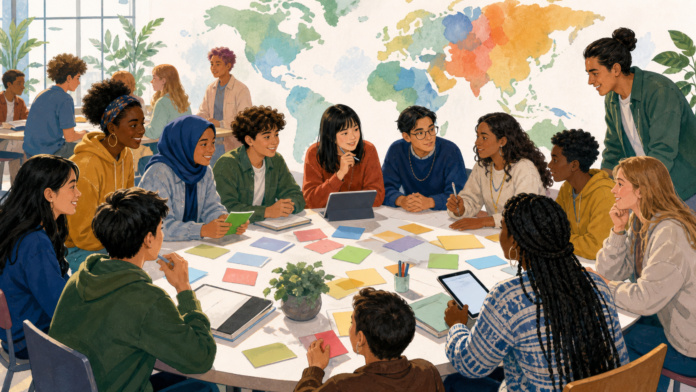
A global UNESCO consultation is inviting people aged 11 to 30 to help define priorities for the education agenda that will follow the Sustainable Development Goals.
Education planning is starting with young people
The international goals that currently guide education policy run to 2030, but work on what comes next has already begun. In 2026, the SDG 4 High-Level Steering Committee launched a three-year consultation process to identify priorities and strategies for a post-2030 education agenda.
One of the first formal work streams is being led with young people rather than waiting to invite them after a policy framework has already been written. UNESCO and the SDG 4 Youth and Student Network are gathering input from people aged 11 to 30 through a global survey, regional meetings, youth-led debates, and group discussions organized by schools and community organizations.
The consultation asks participants to consider three broad themes: the world they hope to live in, the changes they want in education and learning, and the actions they are prepared to take. The questions are intentionally wider than school timetables or individual subjects. They invite ideas about technology, well-being, participation, curricula, learning environments, rights, and inclusion.
That design is good news because it treats students as people with relevant experience, not merely as recipients of decisions made elsewhere.
Regional conversations add context to a global survey
The online survey remains open until September 20, 2026, and is available in numerous languages. Participants can respond individually or work with friends, classmates, or youth organizations to submit a group response.
Regional consultations add another layer. Meetings for Africa and for Europe and North America were scheduled for July 31. An Asia-Pacific session followed on August 4, with Arab-region and Latin American and Caribbean meetings scheduled for August 7. UNESCO says regional variations are possible so discussions can reflect different contexts.
The intended participants include young people, student organizations, and youth advocates. UNESCO's design also calls for attention to voices that are often less heard, including people from marginalized, remote, displaced, or underrepresented communities.
That focus matters because a global average can hide sharply different realities. The education priorities of a student facing unreliable internet access may differ from those of someone worried about artificial intelligence in a well-connected school. A regional conversation can preserve those differences instead of compressing them into a single slogan.
Responses have a defined route into policy discussions
The consultation is not presented as an instant vote on a finished policy. Its planned route is more structured. Regional discussions are expected to produce concise summaries and practical recommendations. Survey responses and consultation inputs will contribute to a Post-2030 Youth Education and Learning Agenda.
Japan's UNESCO school network says youth representatives are expected to use the collected views during a drafting meeting at United Nations University in Tokyo in October 2026. The youth agenda is then due to be presented to global leaders at the 2027 Global Education Meeting.
That meeting is expected to begin a second phase of broader consultation with governments, teachers, civil society, and other education actors. A later phase is intended to consolidate those contributions for intergovernmental discussions about the wider post-2030 development agenda.
The sequence provides a visible path from an individual response to a youth-authored agenda and then to wider negotiations. Whether the final policies reflect that input will still need to be monitored.
Participation is progress, while accountability comes next
Inviting youth input does not guarantee that every recommendation will be adopted. Participation can become symbolic if decision-makers collect ideas without explaining what influenced the final result. The quality of the process will depend on who is reached, whose voices are missing, how responses are summarized, and whether young participants remain involved as negotiations advance.
Still, the consultation establishes something valuable: a formal opening for young people before the next global education agenda is settled. National UNESCO partners in Japan and Latvia are already encouraging participation, extending the invitation beyond UNESCO's central channels.
The immediate opportunity is simple. Young people can describe the education they need for a world shaped by climate pressure, inequality, rapid technological change, and new forms of work and civic life. The longer-term test will be whether institutions show how those ideas shaped priorities.
For now, a global planning process is beginning by asking learners what the future should hold. That is not the end of education reform, but it is a more hopeful and democratic place to start.