
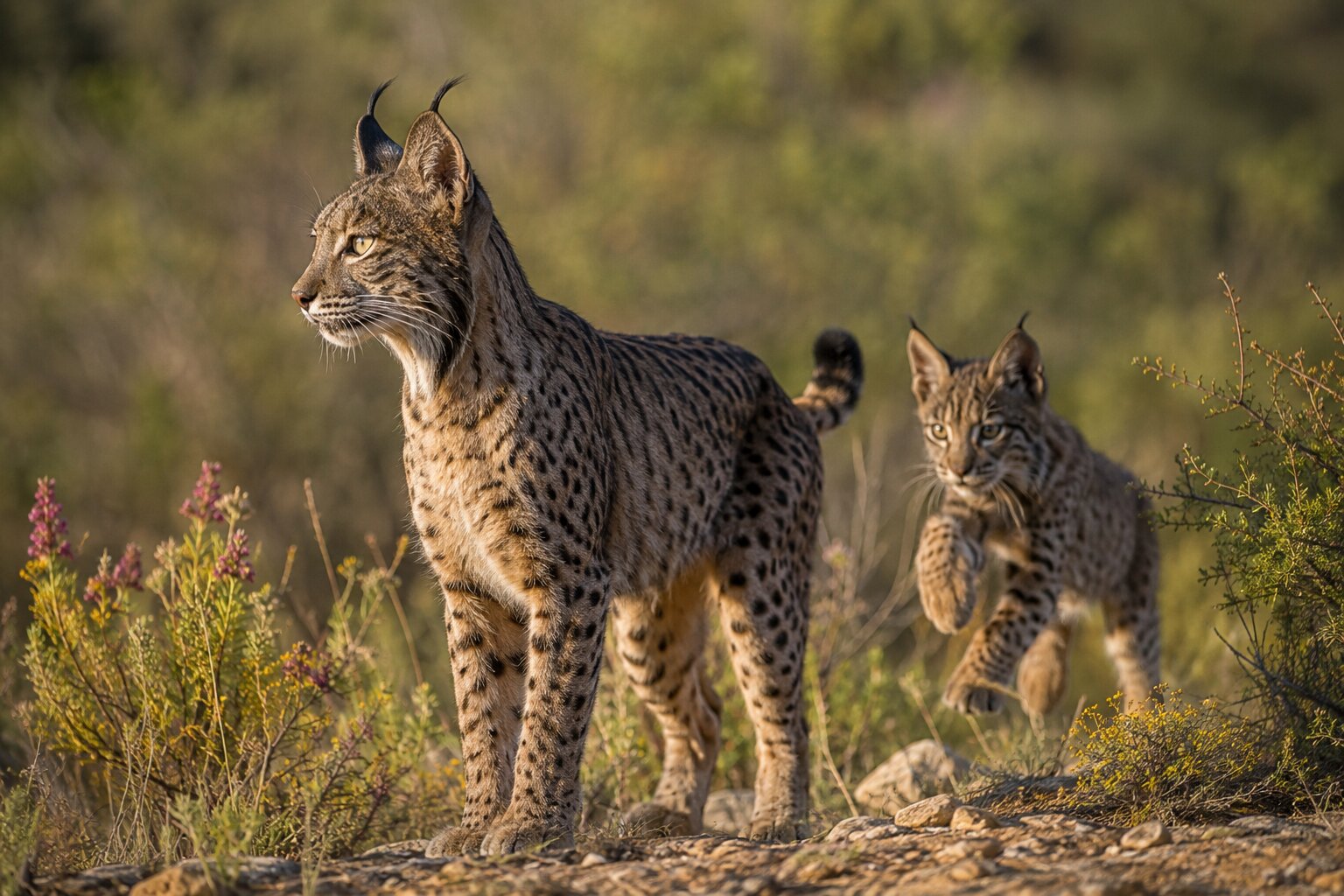
Picture an Iberian lynx and you get one of nature’s best character designs: tufted ears, enormous paws and a beard that makes every animal look slightly unimpressed.
Now there are many more of those faces in the wild.
The official 2024 census counted 2,401 Iberian lynx across Spain and Portugal, a 19% increase in just one year and the highest total recorded since precise monitoring began. That includes 1,557 adults or subadults and 844 cubs born during the year.
The most remarkable number, however, may be the starting point. In 2002, fewer than 100 Iberian lynx remained.
From the edge to a growing population
The Iberian lynx once came dangerously close to disappearing. Its habitat had become fragmented, people had killed lynx directly, and populations of European rabbits—the cat’s main food—collapsed after disease outbreaks.
The response was not one single rescue project. Spain and Portugal combined habitat protection, careful population monitoring, captive breeding, releases into suitable wild areas and work to rebuild connections between populations.
Since releases of captive-born lynx began in 2011, 403 animals had been returned to approved reintroduction areas by the end of 2024. The cats are now breeding in 17 different geographic areas across the Iberian Peninsula.
That geographic spread is a very useful kind of progress. A species packed into only one or two places can be hit hard by a fire, disease outbreak or other local disaster. More breeding areas give the lynx a better safety net.
The new family numbers look good
The census found 470 breeding or territorial females in 2024, 64 more than the year before. Those females produced 844 cubs, or an average of 1.8 cubs per territorial female.
Spain was home to 2,047 of the counted lynx, while Portugal had 354. Castilla-La Mancha held the largest share of Spain’s population, followed by Andalusia. Stable populations were also recorded in Extremadura and Murcia.
The growth has been especially rapid in recent years. The total stood at 1,111 in 2020, meaning the population added almost 1,300 animals in only four years.
A comeback, not a finish line
This is excellent news, but the lynx has not received a lifetime immunity card.
Conservation teams estimate that about 750 breeding females are needed as one of the demographic goals for a favorable conservation status. The 2024 count of 470 is a major step, but it also shows why the work continues.
Road deaths, illegal killing, habitat fragmentation and the health of rabbit populations remain important concerns. New populations also need safe territory and connections that allow animals to move and mix genetically.
In 2024, the International Union for Conservation of Nature improved the Iberian lynx’s Red List category from Endangered to Vulnerable. That change recognized a genuine reduction in extinction risk, not the end of that risk.
Conservation works when it keeps showing up
The Iberian lynx comeback is a wonderfully practical answer to the idea that environmental decline can only move in one direction.
People protected habitat. Breeding centers raised animals. Field teams tracked them. Communities made room for new populations. Spain and Portugal worked across a national border because, unsurprisingly, lynx do not carry passports.
And the cats responded by doing their part: surviving, roaming and producing hundreds of new cubs.
From fewer than 100 animals to more than 2,400 is not luck. It is what long-term, science-based conservation can look like when people refuse to give up on a species.
Sources
- Spain’s Ministry for the Ecological Transition and the Demographic Challenge — Iberian lynx population grew 19% in 2024 (May 22, 2025, Spanish): https://www.miteco.gob.es/es/prensa/ultimas-noticias/2025/mayo/la-poblacion-de-linces-ibericos-crecio-un-19–en-2024-respecto-a.html
- Spain and Portugal Iberian Lynx Working Group — 2024 Iberian lynx census report (May 2025, Spanish): https://www.miteco.gob.es/content/dam/miteco/es/prensa/Informe%20censo%20lince%202024_16.05.2025.pdf
- IUCN — Iberian lynx rebounding thanks to conservation action (June 20, 2024): https://iucn.org/press-release/202406/iberian-lynx-rebounding-thanks-conservation-action-iucn-red-list