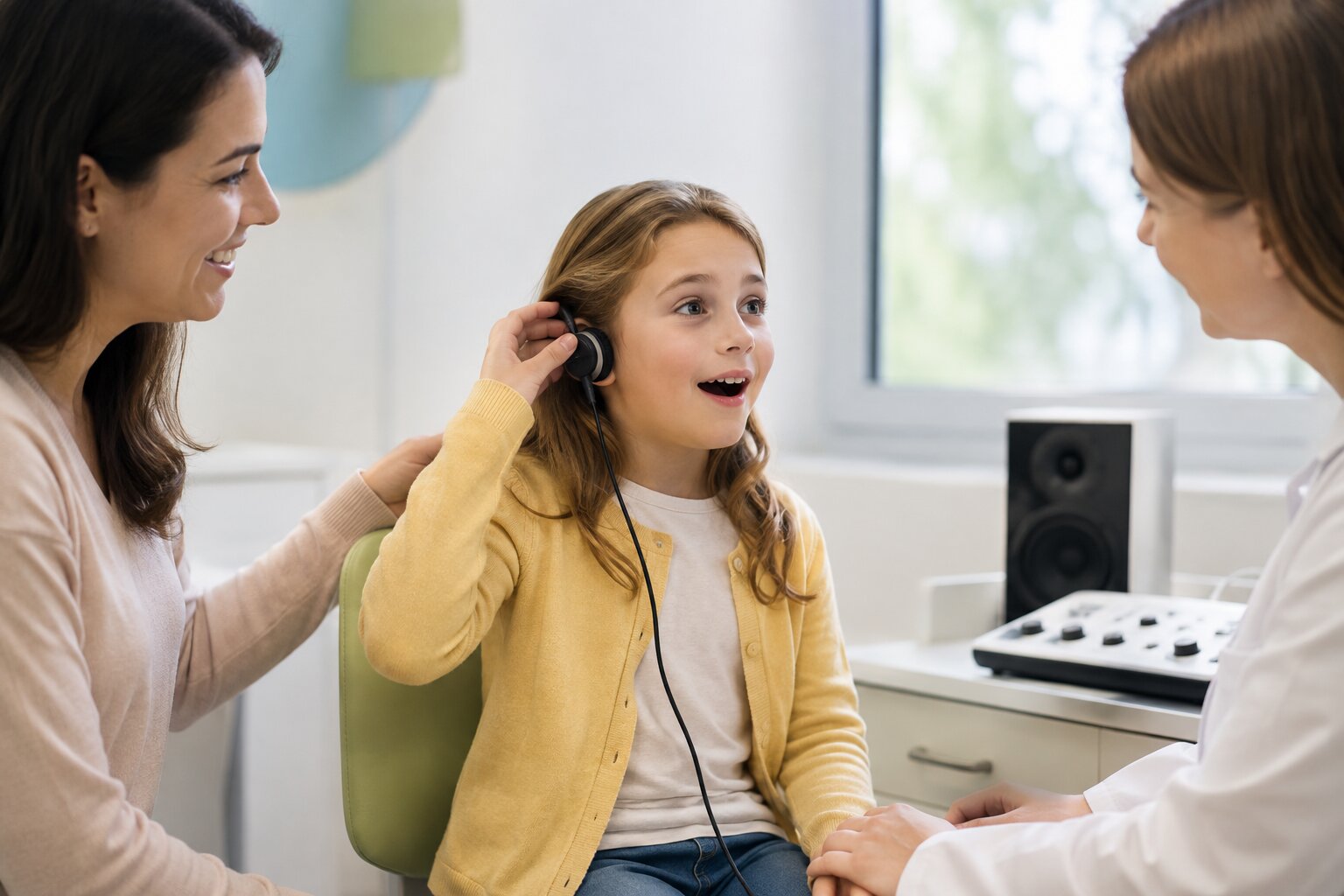
For children born with a rare genetic form of deafness, researchers are testing a striking idea: instead of making sound louder, give the inner ear the missing instructions it needs to transmit sound.
Early results from a first-in-human study suggest that idea can work.
After receiving a one-time experimental gene therapy called DB-OTO, nine of 12 children reached the study’s main hearing target at 24 weeks. Six could hear soft speech without assistive devices, and three achieved average hearing sensitivity within the normal range.
The results were published in the New England Journal of Medicine.
The ear could detect sound—but the message was not getting through
The children in the CHORD study had profound deafness caused by variants in a gene called OTOF. That gene contains instructions for making otoferlin, a protein that helps sensory hair cells in the inner ear pass sound information to the auditory nerve.
Think of the hair cells as microphones and otoferlin as part of the cable carrying the signal onward. In this condition, the microphone can pick up vibration, but the biological handoff is broken.
DB-OTO uses modified adeno-associated viruses as delivery vehicles. They carry a working copy of the otoferlin instructions into the relevant cells. Because the OTOF gene is too large to fit comfortably into one vehicle, the therapy splits the genetic cargo between two; inside the cell, the parts are used to produce the full protein.
The treatment was infused into the cochlea, the spiral-shaped hearing organ in the inner ear, during a surgical procedure.
What the study found
All 12 participants had hearing loss averaging more than 90 decibels before treatment—profound deafness in the study’s definition.
At 24 weeks, nine children had an average hearing threshold of 70 decibels or better and also met the study’s brain-stem-response target. A threshold measures the quietest sound a person can detect; lower numbers indicate better sensitivity.
The everyday result is easier to picture: six participants could hear soft speech without hearing devices. Three reached average sensitivity in the normal range.
Researchers also monitored balance, laboratory results and other possible side effects. Sixty-seven adverse events were reported or worsened during or after treatment, but none caused a participant to leave the study. That number needs context: an “adverse event” means any medical issue recorded during a trial, not necessarily one proven to have been caused by the therapy.
Exciting, with a sensible amount of caution
This was an open-label, single-group study. There was no untreated comparison group, and only 12 children had been enrolled. The therapy is investigational, the trial was funded by its developer, Regeneron, and longer follow-up is essential.
The result also applies to one specific cause of deafness: harmful OTOF variants. It is not a treatment for every form of hearing loss.
And hearing technology already exists. Cochlear implants can provide effective access to sound for many people, while Deaf communities rightly emphasize that deafness is not simply a problem waiting to be “fixed.” A new therapy would be an additional option for some families, not a verdict on anyone’s identity or choices.
A small trial with a big idea
The hopeful part is both the result and the method. Researchers did not replace the inner ear or build a new pathway around it. They helped existing sensory cells complete a task they were genetically unable to perform.
Nine children meeting the main target does not make the therapy ready for routine use tomorrow. It does show that natural acoustic hearing can be improved—sometimes dramatically—in children with this particular genetic condition.
That is how responsible breakthroughs often begin: a small, carefully watched group; a clear biological idea; results strong enough to justify the next study; and families brave enough to help science learn what is possible.
Sources
- New England Journal of Medicine — DB-OTO Gene Therapy for Inherited Deafness (published online October 12, 2025; 2026 issue): https://www.nejm.org/doi/full/10.1056/NEJMoa2400521
- ClinicalTrials.gov — CHORD study record, NCT05788536: https://clinicaltrials.gov/study/NCT05788536
- Regeneron — CHORD trial background and updated DB-OTO results (February 24, 2025): https://www.globenewswire.com/news-release/2025/2/24/3031461/0/en/Latest-DB-OTO-Results-Demonstrate-Clinically-Meaningful-Hearing-Improvements-in-Nearly-All-Children-with-Profound-Genetic-Hearing-Loss-in-CHORD-Trial.html